

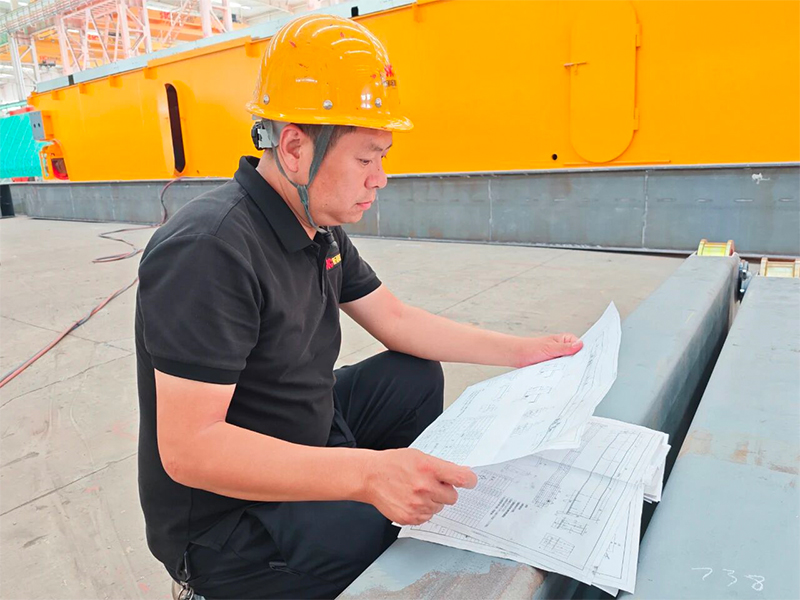
"You have to live up to your profession, and the work you do must meet your own standards. Only then can you live up to your conscience." In the production workshop of Xinke Lifting, Wang Chunqiang, the team leader of the second shift, gazed at the double-beam gantry crane being welded, his words simple yet forceful. Since joining Xinke in 2010, he has been committed to his position for more than ten years, refining the most vivid interpretation of the "craftsman spirit" amidst the interweaving of steel and welding sparks.
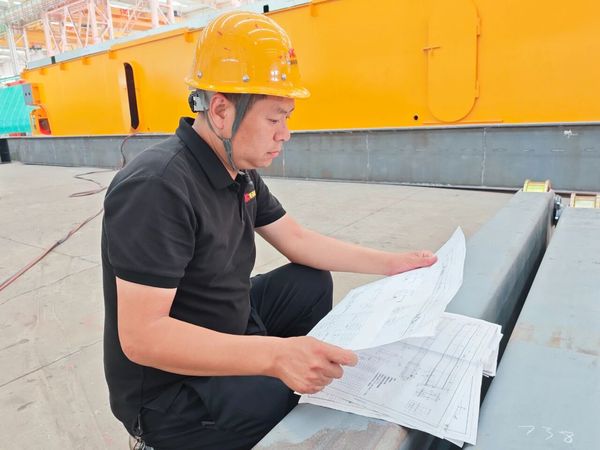
"We take rigor into every process," said Wang Chunqiang. "From the blueprint to the finished product, every step in making a crane must be precise." After receiving a production task, his first step is always to "thoroughly understand the blueprint.".
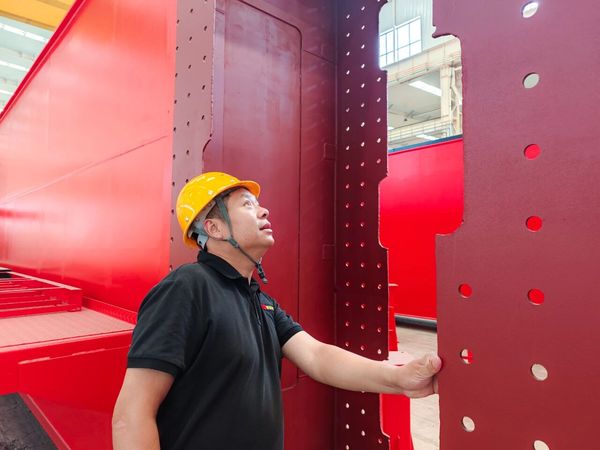
This kind of "rigorousness" is particularly evident in key processes. When talking about the bending and welding part of the casting crane, which is the most technically demanding, he gave an example: "This bending plate is a high-frequency collision part during on-site use. If the welding is not done properly, it is prone to cracking later on, and the flaw is hidden inside, so it is not visible at all if not done according to the process." According to the standard, welding must be done continuously from the arc starting point to the arc termination point through the bend. If the arc is stopped halfway, a hard and brittle layer will form at the joint, posing a safety hazard. "I will keep an eye on the workers to follow the process, even if it takes more time, I cannot let unqualified work pass on."
II. Building a Strong Protective Wall with ResponsibilityDuring the production of cranes, large-scale operations such as lifting beams and turning beams carry extremely high risk factors, and any slight negligence may lead to safety accidents. "This kind of work cannot be assigned casually. We must find experienced and reliable people," said Wang Chunqiang, who has his own "employment standards" - giving priority to experienced technical workers who have been in the industry for many years and are familiar with the characteristics of the equipment. Before operation, he will repeatedly confirm the operation process to ensure that every step complies with safety regulations. "Safety is the bottom line, more important than efficiency. This is not only responsible for the workers, but also for the products."
Three generations of craftsmanship passed down from generation to generation
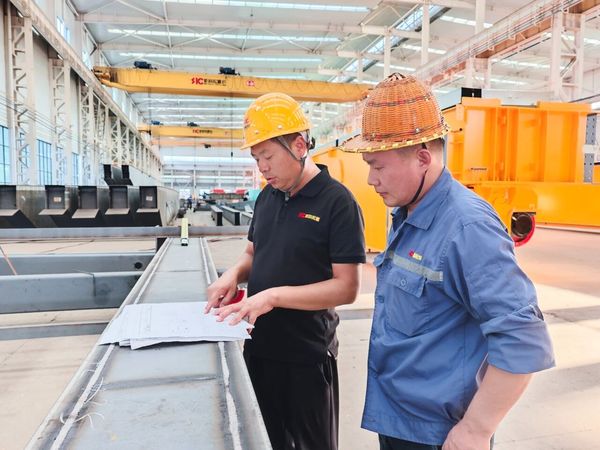
"Newcomers cannot directly engage in core processes; they have to start from assisting." Whenever a new employee joins, he will first have a face-to-face communication to understand the other party's technical foundation, and then arrange simple auxiliary work - such as holding materials for experienced craftsmen to weld, assisting in the transportation of parts, allowing newcomers to familiarize themselves with the working environment and equipment characteristics.
If he encounters an inexperienced young person, he will be more patient: "First, find a scrap of material for him to practice welding. After he finishes welding, I will inspect it and tell him where the arc starting is incorrect and where the arc stopping is too abrupt. Once he becomes proficient, I will let him weld non-essential parts of the crane."
Craftsmanship is not about solitary efforts, but rather about enabling more people to understand the significance of "seriousness" and passing on this reverence for work.


